Leg Room / Jeans
Jeans on the Leg Room rail, read by wash and leg shape
Fourteen pairs from the catalog, each opened and described on 20 October 2026. The tags are ours; the photos and prices belong to the listings.
Jeans in dark, mid and light washes
Sorted the way the finder sorts them: straight first, then tapered, wide and flared. A card with two leg tags shows more than one cut in its photo, and a card with several wash tags is a listing that sells several shades under one page.
 Faded mid-blue jean, back view
Shot from behind on a wooden floor, so the yoke seam, the patch above the pocket and the fade across the seat are all in frame.
- straight
- mid
- full
 Straight jeans with printed back pockets
Nine flat shots of a relaxed straight pair in pale, mid and dark blue plus black; each back pocket carries a printed round motif.
- straight
- light
- mid
- black
- full
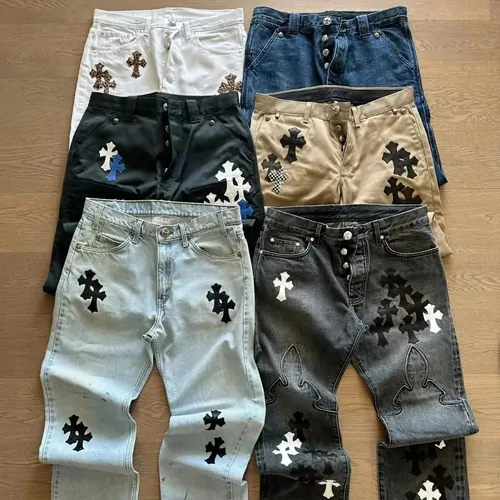
 Mid-blue jean covered in leather cross patches
A single pair photographed flat with its tags still on; dark leather crosses are sewn over both legs, front and back.
- straight
- mid
- full
 Dark straight jean with yellow script down one leg
Deep indigo with whiskers at the hips and a large yellow embroidered script running from thigh to hem.
- straight
- dark
- full
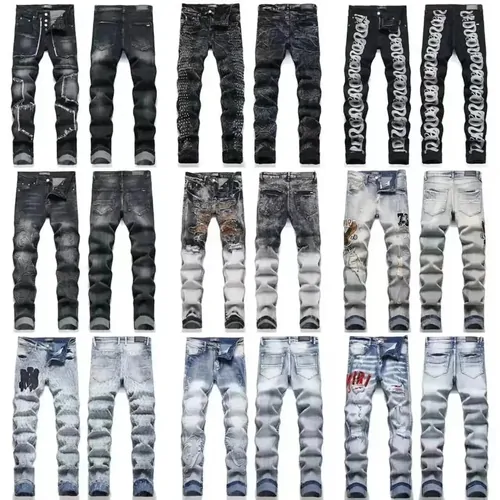
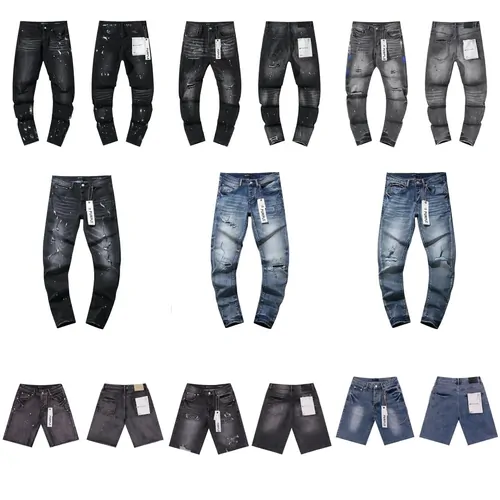
 Board of slim ripped jeans, near-black to pale
One photo laid out as a grid of options, running from almost black to a bleached blue, with knee rips on most of them.
- tapered
- dark
- light
- black
- full
 Black denim in slim and kick-flare cuts
Mostly black and charcoal pairs, some narrow through the calf and a few opening into a small flare with a raw edge.
- tapered
- flared
- black
- full
 Black jean with studs and a painted line
Two views of a slim black pair: a studded patch on one thigh, worn-through knees and a hand-painted stroke on the back leg.
- tapered
- black
- full
 Baggy jeans with big stitched graphics
A collage of loose, wide pairs with large embroidery running down the back of the leg, in black, gray and two blues.
- wide
- black
- mid
- full
 Wide pale-blue jean with light wear marks
The lead photo is a very wide, almost puddling light pair; the smaller pictures beside it are other cuts under the same listing.
- wide
- light
- full
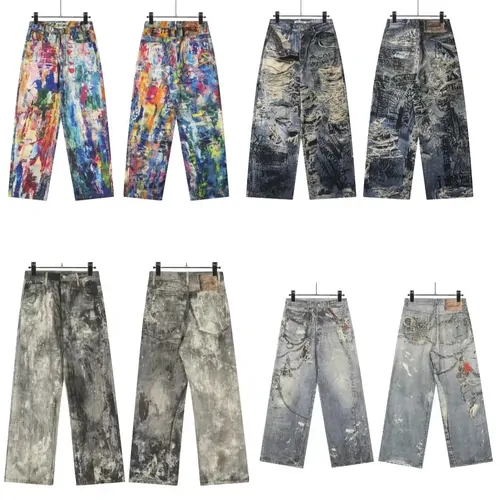
 Wide jean with an all-over worn-in print
Hung on clips front and back, so the busy blue-and-sand pattern reads from waistband to hem; the leg is wide and straight.
- wide
- mid
- full
 Near-white wide jeans on a hanger
Bleached almost to white, cut wide and full length, photographed with the swing tag hanging from the belt loop.
- wide
- light
- full
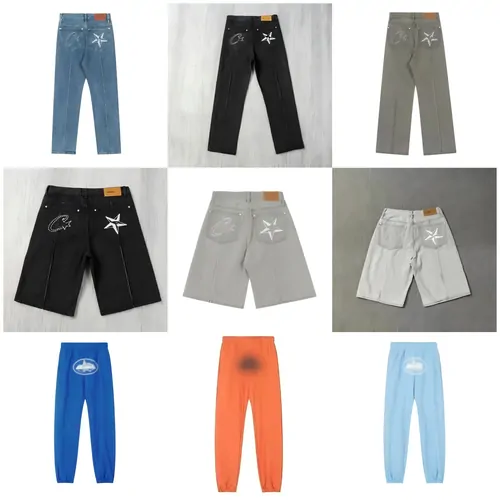
 Raw-hem flares, pale and black
Kick-flare jeans finished with cut, fraying hems; the listing also sells a light denim short, so check which option carries the price.
- flared
- light
- black
- full
 Flared jeans in light, dark and two-tone
Three pairs laid flat side by side: a light wash, a dark wash and one with a contrast panel down the outer leg, all with raw hems.
- flared
- light
- dark
- full
 Bootcut and flared pairs with paint flecks
Fifteen small photos of bootcut and flared jeans in blue, black and brown, several with paint marks or patched holes.
- flared
- mid
- dark
- black
- full
What a wash word on a jean listing usually covers
Sellers describe wash with a handful of Chinese words: 深蓝 for deep blue, 浅蓝 for light blue, 水洗 for a washed finish, 做旧 for an aged look. They help with searching and they are loose for judging. One shop’s 浅蓝 can sit close to another shop’s mid blue, because the word describes that seller’s own range rather than any shared scale.
We tag wash from the photo instead, on four steps: dark, mid, light and black. Two habits make a photo more useful than the word. Look for a shot taken in daylight on a plain floor, since studio shots on white tend to lift the color by a step. Then compare the thigh with the hem: a pair that is evenly pale reads very differently in person from one that fades from a dark hem to a pale thigh.
If the shade matters to you, put it in the note to the buyer when you order, copying the option name exactly as the listing spells it, and ask for the arrival photos to be taken in natural light. Most agents photograph an item when it reaches the warehouse; what they shoot, and how many frames, differs from one agent to the next.
Reading leg shape from a flat-lay photo
A pair laid flat shows the outline of the leg and flattens the drape. Three checks tell you most of what you need. Compare the width at the knee with the width at the hem: equal means straight, narrower at the hem means tapered, wider means flared. Then look at the seat, because a wide jean is roomy from the hip down and its outline is broad well before the knee. Last, watch where the hem meets the edge of the photo; sellers often fold a long hem under, which hides a stacked length.
On-model photos settle the question faster and bring their own trap, the model’s height. A full-length wide jean on a tall model can pool on someone shorter. When a listing gives 裤长 (trouser length) in centimeters, lay a pair you already own flat, measure along the same line and compare the numbers instead of the look.
Our leg tags follow the knee-to-hem check above. Where a photo shows two cuts, the card gets both tags; the black denim card on this rail is one of them, mixing narrow pairs with small kick-flares.
Rips, patches and stitched graphics seen up close
Surface work is where jean listings change most between one photo and the next. A rip can look fresh in one frame and frayed in another. A patch can be sewn on or printed. Embroidery that looks crisp in the seller’s lead photo can look flatter in a warehouse phone photo.
Before ordering, find the closest crop the seller offers and check three things: whether the edges of a patch are stitched down or only printed, whether a rip is backed with fabric so the hole will not keep growing, and whether a graphic sits on the front or the back of the leg. Our card notes say which side carries the decoration whenever the photo shows it, because back-leg graphics on this rail are easy to miss from the front.
If the standard arrival photos skip the decorated area, ask for a close shot of it. Most agents sell extra photos as an add-on, and what one costs is set by each agent.
Multi-option jean listings and the option you pay for
Many listings on this rail are collections: one page, one headline price, and a grid of styles behind an option menu. The headline price is often the cheapest option, which may not be the pair in the main photo. Each card shows the price the listing displayed on the day we read it; where the listing showed a range, the card shows the range.
Three habits keep a multi-option order clean. Screenshot the option you want with its label in view. Copy that label exactly, Chinese characters and all, into the order note. Then check the size list again after picking the style, since on some listings each style has its own sizes and a 36 in one may not exist in another.
When an agent’s system loads the listing for you, the option menu usually arrives as buttons you can click. When it does not, you type the option name yourself, and that is where most mix-ups begin.
Jean sizes on Chinese listings
Jean listings on Chinese marketplaces usually sell by a waist number such as 28, 30 or 32, and the chart that explains those numbers is a photo, often the fifth or sixth image, in centimeters. The chart tends to give waist, hip, thigh, leg opening and length for each size. Read the waist figure as the flat garment measured edge to edge and doubled, or as the full circumference, depending on how the chart is drawn; the header usually says which.
Measure a pair that fits you the same way and pick the size whose numbers sit closest, giving more weight to the waist and the thigh than to the length, which a tailor can shorten. Where the chart and the option menu disagree, write the measurement you want in the order note as well as the size label.
We leave size out of the tags because the same label covers different measurements from one shop to the next. That gap is also why a pair that fit last time is no guide to a new seller.