Leg Room / Trousers
Trousers on the Leg Room rail, from canvas work pairs to soft lounge cuts
Thirteen pairs that are neither jeans nor sweats: carpenter and cargo trousers, dress trousers, corduroy and a few lounge cuts, read and tagged on 20 October 2026.
Canvas, nylon and corduroy trousers in one line-up
The same order as the finder: straight, tapered, then wide. The wash tag on these cards stands for overall tone, so olive and tan count as mid, navy and charcoal as dark, cream and white as light.
 Canvas carpenter trousers, olive and black
Four pieces folded flat with swing tags showing: a big patch pocket on the thigh, a square label and a tie cord at the waist.
- straight
- mid
- black
- full
 Black elastic-waist cargos on a rail
Back view on a chrome rail: elastic waist with belt loops, flap pockets low on the thigh and a roomy straight leg.
- straight
- black
- full
 Cargo trousers in black, tan and olive
Three hanging pairs with a round lens detail set into the thigh pocket; the leg runs straight and narrows a little at the ankle.
- straight
- black
- mid
- full
 Flat-front dress trousers in navy, khaki and black
Hung by the waistband with paper tags; plain fronts, belt loops and a straight leg with a pressed crease.
- straight
- dark
- light
- black
- full
 Mustard corduroy five-pocket trousers
Front and back on a carpet with swing tags attached; wide-wale cord in a warm ochre and a regular straight leg.
- straight
- mid
- full
 Gray and black nylon cargos with a lens pocket
Two lightweight pairs on hangers, elastic at the waist and a round lens detail on the cargo pocket.
- straight
- mid
- black
- full
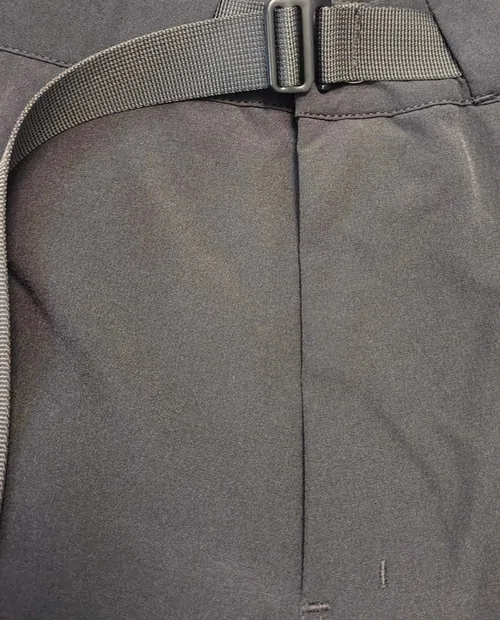
 Charcoal stretch trousers with a bonded waistband
Shown worn, with a close-up of the waist; the Chinese note on the photo says the waistband edge is taped instead of stitched so it lies flat.
- tapered
- dark
- full
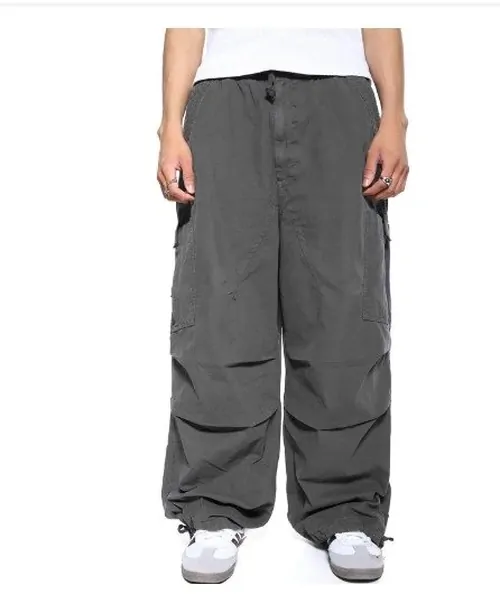
 Loose black cargo trousers with cord hems
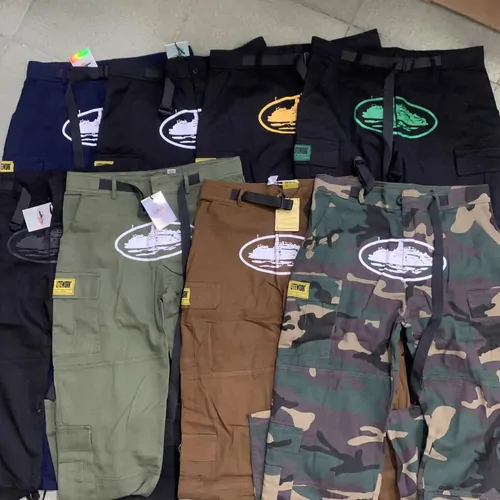
Nine product shots, nearly all black, with thigh pockets, a printed graphic on several and cords at the hem; one navy pair sits in the corner.
- wide
- black
- dark
- full
 Bright blue carpenter-style work trousers
Front and back laid on asphalt: doubled knee panels, a utility loop and a side tool pocket, all in a saturated workwear blue.
- wide
- mid
- full
 White baggy trousers with a large dragon print
Worn by a model in sandals; a gray dragon wraps one thigh and the hem pools over the foot.
- wide
- mid rise
- light
- full
 Cream parachute-style trousers with a long cord
On a model: light cream fabric, a drawcord hanging past the hip and a wide leg gathered slightly at the shoe.
- wide
- mid rise
- light
- full
 Navy textured wide-leg trousers, worn
A showroom photo of a woven, slightly ribbed navy fabric with a wide leg that rests on the shoe.
- wide
- dark
- full
 Black high-waist lounge trousers
Worn with the waistband pulled well above the navel; a soft, heavy drape and a wide leg that just clears white sneakers.
- wide
- high rise
- black
- full
Work trousers and what the extra pockets are for
Carpenter and work trousers carry a set of details that show up clearly in photos: a hammer loop on the side seam, a narrow tool pocket on the thigh, a second layer of fabric over the knees and heavy bar tacks at the pocket corners. The more of those you can see, the closer the pair is to its working original; listings that drop them are often cut lighter.
Photos also tell you about the fabric weight in an indirect way. Canvas that holds a crease where it folds, with sharp edges at the pocket openings, is usually a firm cloth. Fabric that drapes over the edge of a table or ripples at the knee is lighter. We note what a photo shows and do not guess a weight the listing does not state.
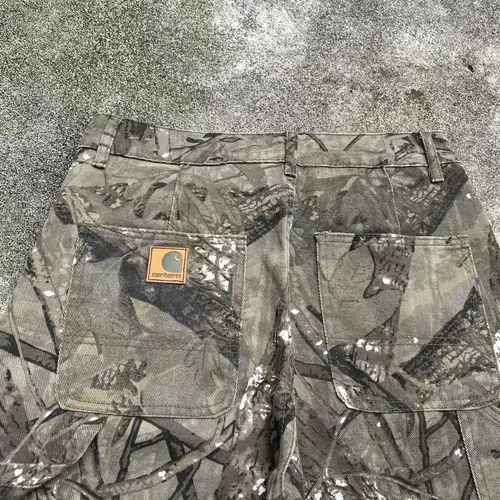
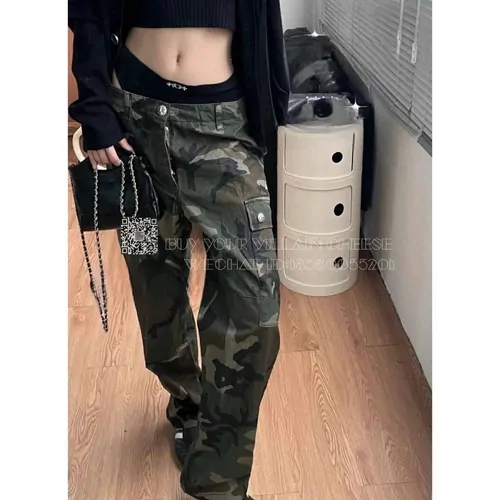
Camouflage and washed work trousers vary more than plain ones between photos and stock, because the print placement and the wash shift from piece to piece. If the pattern matters, ask for an arrival photo of the front.
Cargo pockets, lens details and elastic waists
A cargo pocket sits in one of two places: on the side of the thigh, where it bulges when full, or low on the front of the leg, where it hangs flatter. Look at the side view before you decide; a pocket that sits on the front changes the line of a wide leg more than one on the seam.
Several cards on this rail mix an elastic back with belt loops. That combination gives you room at the waist without losing the option of a belt, and it also means the waist measurement on the size chart is stretched or relaxed; charts usually state both or only the relaxed figure. Toggles or cords at the hem let a straight cargo turn into a gathered one, which matters if you plan to wear it over high shoes.
The round lens detail on two cards is a design feature on the pocket flap, not a fastening; read the close-up photo to see whether it is sewn in or clipped on.
Waistbands: elastic, belted and bonded
A trouser waist is built one of three ways on this rail. A fixed waist with belt loops and a button needs the right size from the chart. An elastic waist forgives a size either way but bunches if the trouser is much larger than you. A bonded or taped waist, like the charcoal stretch pair, replaces the inner stitching with a pressed strip so the band lies flat under a shirt.
Photos give away which one you are looking at. Gathering across the back means elastic. A clean band with a hook and bar means fixed. A close-up that shows no stitch line on the inner band means bonded, and the seller usually says so in the photo text because it costs more to make.
If you sit between two sizes, an elastic or adjustable waist is the easier buy at a distance. A belted fixed waist leaves less margin.
Where a waistband sits, seen on a body
Rise runs from the crotch seam to the waistband’s top edge, and a flat lay barely shows it. That is why only three trouser cards carry a rise tag: they are the pairs photographed on a body, where you can see whether the band sits at the navel, a hand below it, or lower.
On-model photos also show drape. A soft fabric falls straight from the hip and breaks once over the shoe; a firm one stands away from the leg and keeps its shape at the knee. Mirror photos taken by buyers, which some sellers repost, are often the best view of how a wide trouser behaves when someone walks.
If the listing gives a front rise in centimeters, compare it with a pair you own. A difference of a few centimeters is the gap between a mid and a high rise on most bodies.
Fabric you can judge from a photo, and fabric you cannot
Some fabrics announce themselves. Corduroy shows its wale, nylon catches the light along its folds, and canvas holds a sharp edge. Others are harder: a cotton twill and a polyester blend can look the same in a flat lay, and only the listing text or the label photo tells them apart.
When the listing names a fabric, it is usually in a line such as 面料 (face fabric) followed by percentages. Where a seller gives no composition, our card says what the photo shows, a sheen or a texture, and stops there.
Color is the other limit. Mustard, olive and tan shift a great deal between screens, so if you are matching a trouser to something you already own, ask for an arrival photo next to a plain white sheet.